
City of Belmont
Charlotte Water is partnering with the City of Belmont to replace the existing Belmont Wastewater Treatment Plant with a new pump station and wastewater pipelines.
Through this work, Belmont’s wastewater will be able to travel to Charlotte for treatment, providing more efficient wastewater service and meeting the future wastewater needs for communities in northwestern Mecklenburg County and eastern Gaston County.
This partnership will allow the City of Belmont to provide more cost-effective and environmentally-conscious wastewater management services to our residents and customers, while also ensuring that we have the necessary infrastructure and treatment capacity to manage wastewater services as our region continues to grow.
The City of Belmont is working alongside Charlotte Water every step of the way on this regional project. We want to ensure our residents continue to receive excellent, undisrupted wastewater service.
Bemont's coordination with Charlotte Water will allow us to:
- Decrease the number of places where wastewater is discharged to the Catawba River.
- Reduce the cost of future wastewater treatment expansions or upgrades by taking advantage of inclusion in a larger regional facility.
- Meet increasingly stringent environmental regulations by treating Belmont’s wastewater at the state-of-the-art Stowe Facility.
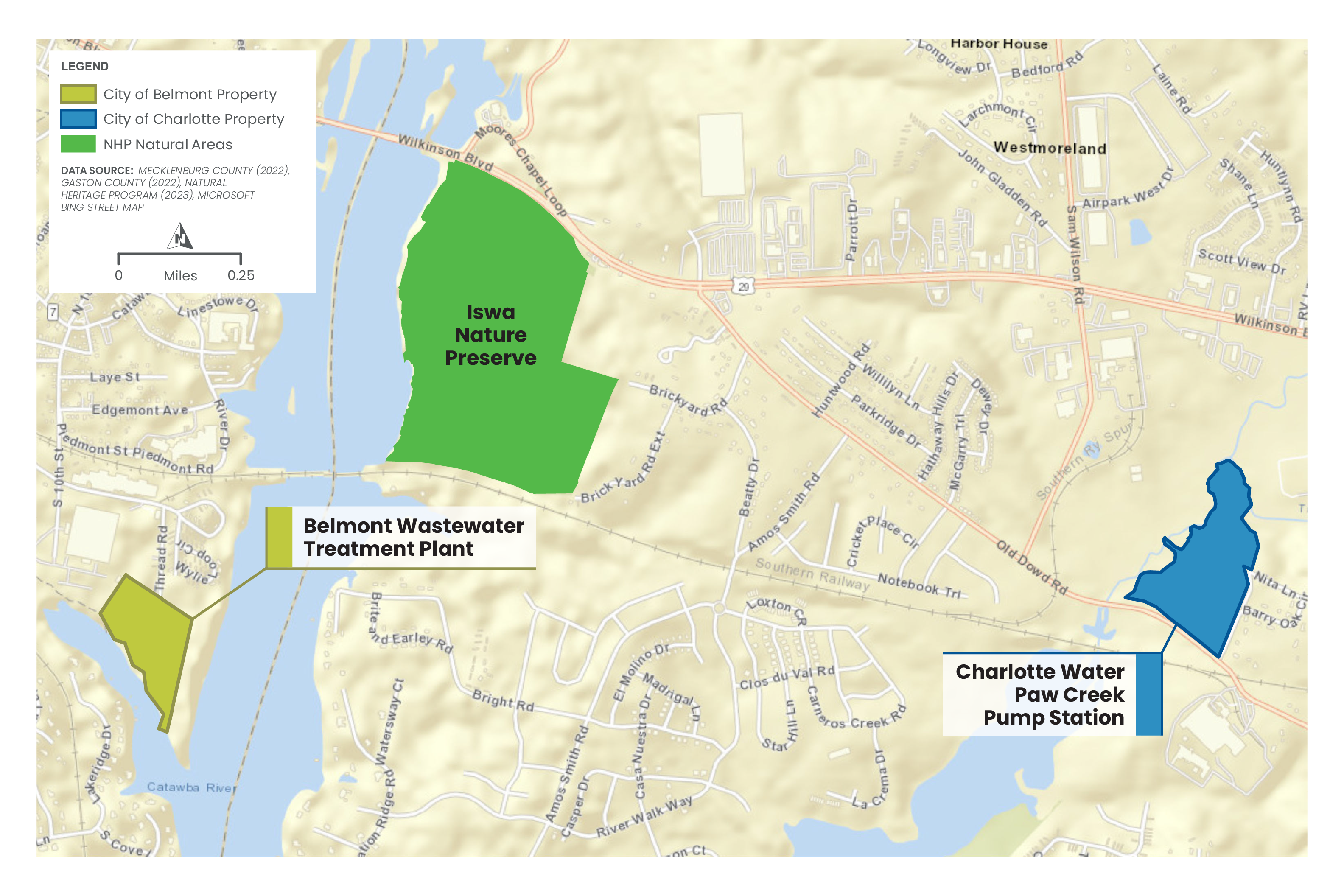
Belmont Pump Station and Wastewater Pipelines Project
The new Belmont Pump Station will be built at the site of our current Belmont Wastewater Treatment Plant on Parkdale Drive, allowing us to repurpose many of the existing structures.
This pump station will be connected to Charlotte Water's wastewater collection system at the Paw Creek Pump Station on Old Dowd Road in Charlotte. Underground pipelines will be installed connecting the new Belmont Pump Station to the existing Paw Creek Pump Station.
The future wastewater pipelines will be located deep underground in bedrock that is approximately 65 feet below the Catawba River, which is about the height of a 6-story building. We have already installed two of these crossing in Mount Holly to connect the new Mount Holly Pump Station to the Stowe Facility. You can learn more about the construction process on the Wastewater Pipeline Installation page.
STATUS: The design team began survey work in March 2023 to help determine the best route for the new wastewater pipelines. Several factors are weighed when selecting the best route including existing land use, environmental resources and habitats, and the type of rock and soil composition.
NEXT STEPS: Once the best route is determined, we will identify properties where Charlotte Water needs a permanent easement or temporary construction easement agreement. An easement agreement allows use of part of a property owner’s land for a specific purpose, after a legal agreement has been reached. Charlotte Water representatives will be in touch with those property owners to discuss the easement process.
SCHEDULE:
Design and Easements: 2023 - 2026
Construction: 2026 - 2029
Learn more about how we are surveying the Catawba River in the video below!
Frequently Asked Questions
What will happen to the current Belmont Wastewater Treatment Plant?
In coordination with the construction of the Stowe Regional Water Resource Recovery Facility, Belmont will construct a new pumping facility to send wastewater flows to the Charlotte Water system. The new pumping facility will be built at the site of the current Belmont Wastewater Treatment Plant, allowing us to repurpose many of the existing structures.
Will water and sewer rates increase once Belmont discharges flow to Charlotte Water?
Through the budget process, the fee schedule is determined by the City Council each year. Due to the many contributing factors of this project, the updated fees will not be determined until the end of the construction phase. For more information on current utilities, please visit the City of Belmont Public Works website.
How will the Stowe Regional Water Resource Recovery Facility benefit the City of Belmont?
- Consolidate three wastewater treatment plants into one state-of-the-art facility: Three wastewater plants currently operate alongside the same section of the Catawba River – two municipal plants in Mount Holly and Belmont and a private industrial wastewater plant. These plants are aging and require multiple upgrades to meet the expanding needs of our community. The new Stowe Facility will consolidate operations, add additional capacity and treat wastewater more efficiently than the current plants.
- Meet the growing needs of our community, processing 15 million gallons of wastewater per day: The Stowe Facility is the most feasible and cost-efficient solution for adding wastewater capacity for our area. It will operate 24 hours a day, seven days a week. more efficiently than the current plants.
- Be more energy efficient, reducing our carbon footprint: This facility represents a regional approach to a more cost-effective and environmentally conscious effort towards wastewater treatment services. It works towards our focus of building more sustainable and resilient communities.
- Contribute to our community: Charlotte Water is dedicated to implementing a Community Benefit Project on the land outside the Stowe Facility to serve as a resource and amenity for the Belmont community. The Online Workshop provides Belmont residents with an opportunity to participate in sharing their ideas for this project.
How long will construction take?
Construction of the new pump station and wastewater pipelines is anticipated to occur from 2026-2029. Once the new pump station is in service, the City of Belmont will begin decommissioning the existing wastewater treatment plant.
Have a general question about your water or wastewater service?
Contact the City of Belmont Water and Sewer Maintenance Supervisor Danny Whisnant at (704) 901-2073 or dwhisnant@cityofbelmont.org.
How will you be crossing the Catawba River?
We are using horizontal directional drilling to install the wastewater pipelines. HDD is a safe, industry-preferred way to install pipelines under water because there is minimal ground disturbance. You can learn more about this construction process on our Wastewater Pipeline Installation page.